AI Sentiment Analysis for kids creative writing 2025
Howdy, parents or instructors, if you are interested in enhancing your child’s writing skills, then it’s going to be a treat for you because this is not a typical blog post suggesting multiple tools or a list of tips to apply. Instead, we are going to step up into how AI Sentiment Analysis for Kids can help us in turning our kids’ dull or straightforward stories into more vibrant stories of joy or emotional adventures, sparking the kids’ love for writing, all explained in a way that is simple and safe for both parents and kids, even for non-techie parents.
Here, I’m not going to suggest tools or a list of tips to follow; rather, we are going to discuss an AI feature. As a master of computer science and someone with years of experimenting with multiple tools, be they AI-powered or Cloud-based, I have come to realize that this feature of AI is really helpful for me in transforming my niblings’ story writing skills to the next level. The main goal is to develop a sense of self-awareness through writing and to introduce children to AI as a tool to optimize their daily chores, making it fun for children without tech overwhelm in this ever-evolving world of tech, because why not? In this era of AI.
Table of Contents
Kids Find AI and Writing Intimidating
You may have seen your child being vacant towards AI thinking it’s tricky or cumbersome to use with tasks like writing or any other day-to-day activity, or they may think AI is only for grown-ups. My niece used to think AI is something related only to robots or heavy operating machinery. It’s the responsibility of teachers or parents to introduce children to these useful aspects of tech in a safe and healthy environment, in a fun and clear way; otherwise, they may lag behind in a critical skill of 2025.
What Is AI Sentiment Analysis?
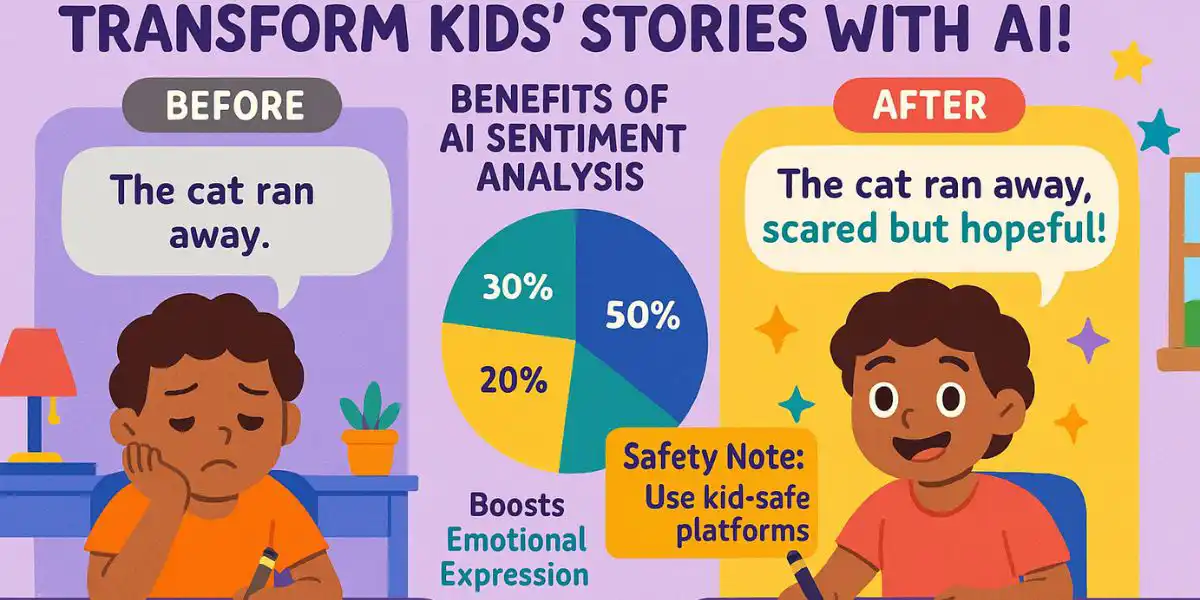
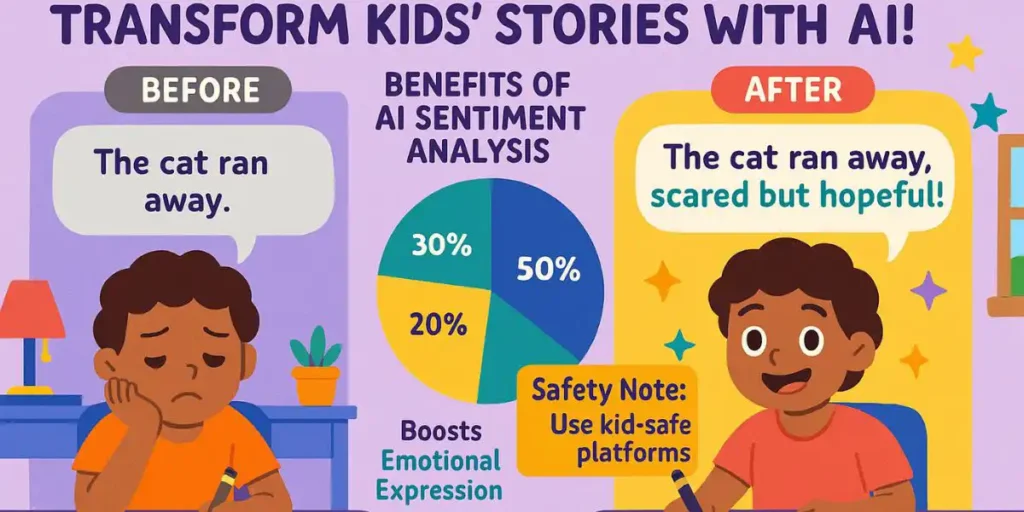
AI Sentiment Analysis works by scanning the writing to identify the emotions, just like a detective. for example, your kid writes a short story ” the robot meets the aliens” that might be plain, lacking emotions. The AI Sentiment Analysis flags it as neutral and would suggest ways to add emotions. I have seen this with my niece’s “puppy story”; the AI flagged sad moments and gave her some suggestions, which then added the element of curiosity in her writing and led to a joyful ending
Make your Kids Emotion Detectives through AI Sentiment Analysis for Kids’ creative writing.
It’s high time to introduce our kids to these useful aspects of tech. So, they will develop a sense of algorithms working behind the scenes and how AI could boost their skills instead of replacing them, which will help them enhance their cognitive abilities. Instead of consuming that short-term content, which is actually disturbing their attention spans and turning them into addictive consumers, AI sentiment analysis for kids also creates a sense of problem-solving in kids, which is a great skill in the current times.
Step-by-Step Guide to Introduce Kids to AI
Below are the steps to make “AI Sentiment Analysis for Kids’ Creative Writing” a fun game without making them feel it’s boring. The goal here is to introduce AI features as a game to improve their learning abilities and self-awareness through writing.
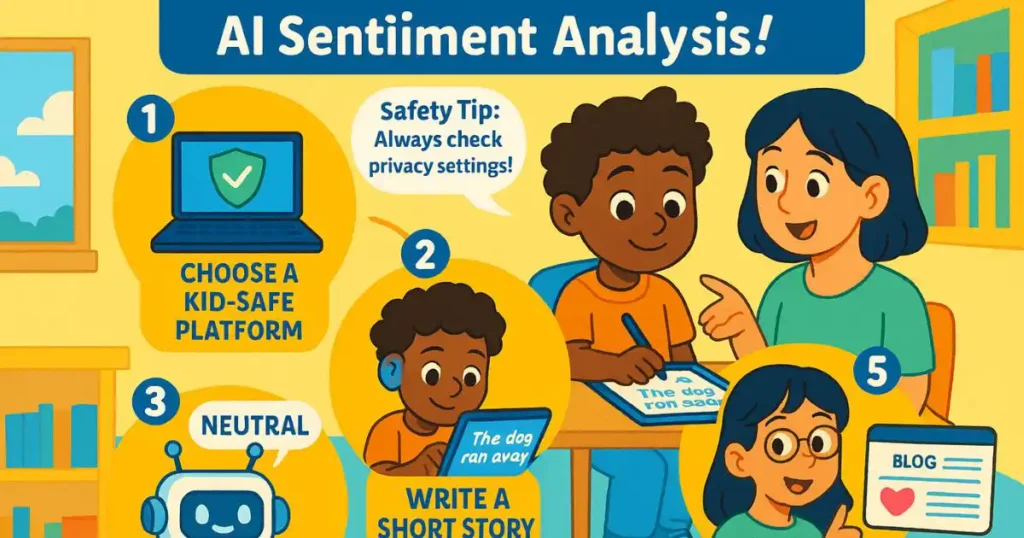
Step 1: Set Up a Safe Environment
Try to choose a kid-safe platform that provides privacy to keep your kids’ activity secure. There are multiple platforms in the market that you can try based on your preferences; here are a few of them: Writecream, StoryBee, or Kidgeni—these platforms provide sentiment analysis with an easy-to-use interface. So, it won’t be tech overwhelming for you or your child. Writecream offers an offline mode, StoryBee needs a parent account to run, and in Kidgeni, you can disable sharing your kids’ activity. I personally used to check settings for my niblings’ activity.
Step 2: Start with a Tiny Story
Ask your kid to write a short story; to keep it easy in the beginning, they may write, “I met an alien.” Then, say to them, “Let’s use the sentiment analysis to identify the feelings in your writing.” It takes just a few minutes and makes writing a quick and fun way to explore AI. I did this to my nephew’s story and later added emotions in his writing and also gave him a new perspective on AI.
Step 3: Explore your child’s mood
Try to explore your child’s mood to create an emotionally adaptive story. Ask your kids how they are feeling today. And encourage them to write a story according to their mood. If the kids are happy, they will write a joyful story; if the kids are upset, the story will be a reflective one. The AI then checks if the tone matches their feelings, helping them to express their emotions. My nephew’s “angry robot” story helped us to talk about his feelings after he lost the game.
Step 4: Review and Discuss
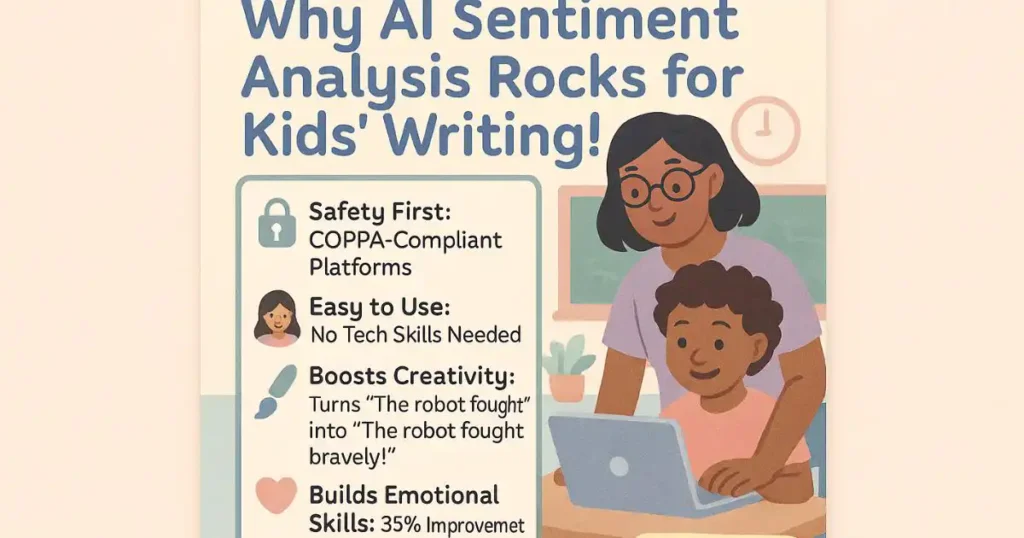
Now review the suggestions of AI sentiment analysis along with your child and ask them questions related to their story. I asked my nephew why the monster in his story is feeling angry, leading to a story full of sentiments, helping him in regulating his emotions. Research shows this increases emotional literacy by 35%.
Your kid’s privacy is important
Prioritize your child’s safety. choose a platform with a clear privacy policy, and avoid sharing personal details or allowing unnecessary permissions. Use offline tools if possible to minimize privacy risk for your child. Always conduct sessions in your presence; AI sometimes suggests odd words not suitable for children.
Conclusion
Now, you have a clear idea of how to use AI sentiment analysis for kids. This feature is not just about tech; in fact, it’s a tool to boost your kids’ emotional capabilities and to supercharge their confidence. It will give your kids an overview of how to implement advanced AI features in their everyday life to make things easy, without being tech-overswamped.
What is AI sentiment analysis for kids’ creative writing?
AI sentiment analysis is an AI feature that can be used as a tool to scan emotions in children’s writing, be they happy, sad, or neutral, and helps them to write stories full of emotions, boosting their emotional awareness or learning capabilities.
How can AI sentiment analysis help my child’s writing skills?
It helps kids to recognize and add emotions in their stories, making writing a fun and engaging activity for children. For example, if the child writes a neutral story, AI sentiment analysis will suggest emotions like “excited” or “thrilled,” helping kids to write an emotionally vibrant story, contributing to improving their emotional literacy.
Is AI sentiment analysis safe for kids to use?
yes, it’s safe for kids if you choose kid-friendly platforms, keep a check on your privacy settings, and avoid sharing personal info. Always review the suggestions of AI to make sure the suggestions are age-appropriate.
Do I need tech skills to use AI sentiment analysis with my kids?
No, the feature is user-friendly. You just need to set up the platform, paste your kid’s story, and run sentiment analysis. AI will do the rest on its own, but make sure to review the suggestions.
Why use AI sentiment analysis instead of teaching writing myself?
Yes, you can do it manually, but AI will save time and make learning fun for kids, improving their self-learning capabilities.